One year after the introduction of a broad fiscal package targeting consumption, labour and capital, a new analysis by Consilium Policy Advisors Group (CPAG) finds that the adjustment has delivered significant progress in reducing the budget deficit, but, very likely, at a much higher economic cost than necessary.
The analysis examines budget execution up to July 2026 and assesses the measures implemented by the authorities against CPAG’s recommendations from June 2025.
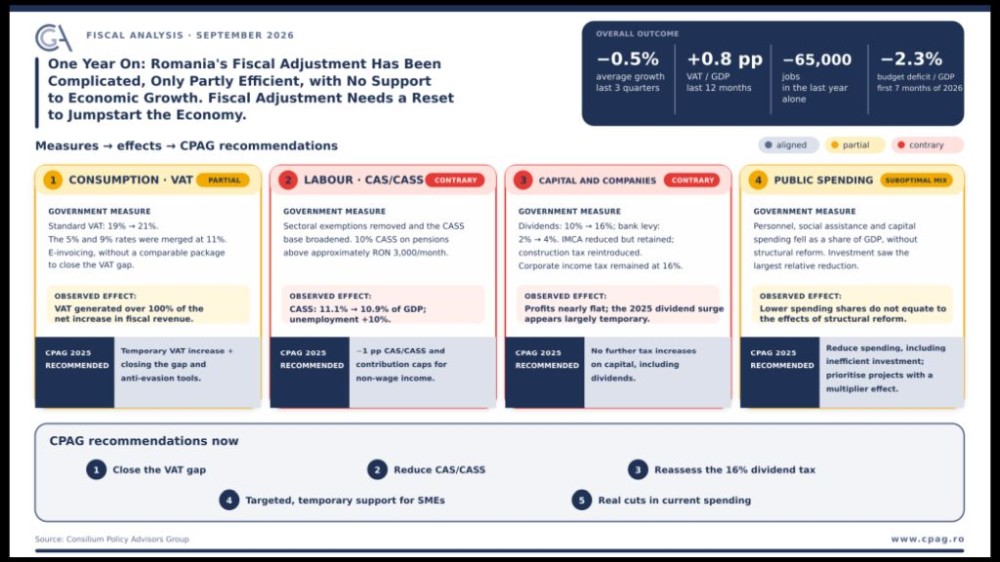
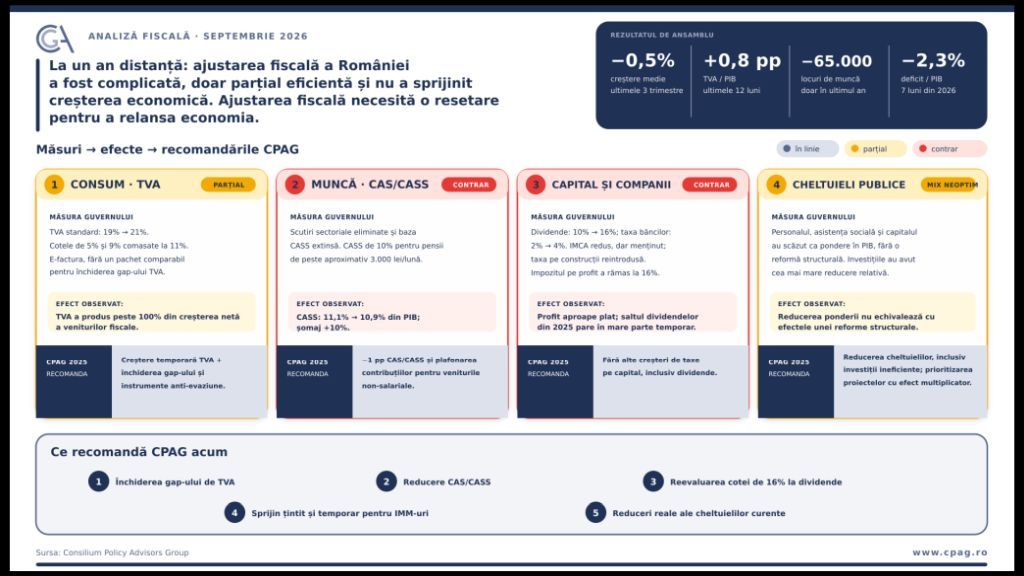
The results show that VAT generated almost all the additional fiscal revenue. On a rolling 12-month basis, VAT revenues increased by 0.8 percentage points of GDP, slightly exceeding the total net increase in fiscal revenues of 0.7 percentage points of GDP.
By contrast, profit and property taxes remained broadly unchanged as shares of GDP, while social security contributions declined from 11.1% to 10.9% of GDP, despite the repeated broadening of the CASS base.
Reducing the budget deficit to 2.3% of estimated 2026 GDP during the first seven months of the year represents significant progress. However, the composition of the adjustment matters equally. Taxes were increased across consumption, labour and capital through several legislative packages, without sufficient sequencing or protection for the components supporting employment, investment and economic growth.
In June 2025, CPAG proposed a simpler package centred on a temporary increase in the effective VAT rate, combined with stronger collection, lower social security contributions and reduced public spending. CPAG warned that simultaneously increasing taxes on consumption, labour and capital lacked economic logic and risked deepening the economic slowdown.
One year later, the data largely confirm this assessment: VAT generated the additional revenue, while measures affecting labour and capital had adverse economic effects without generating additional fiscal gains while weakening the economic bases on which future revenues depend.
Economic growth averaged -0.5% over the last three quarters, despite Romania benefiting from one of the largest inflows of European capital in the past decade through the National Recovery and Resilience Plan.
At the same time, the economy lost approximately 65,000 jobs in one year, equivalent to 1.3% of total employment, mostly in the private sector. The number of unemployed people increased by approximately 51,000, or 10%.
CPAG estimates that these job losses generate a minimum annual fiscal cost of RON 2.5 billion through forgone taxes and social contributions, lower VAT revenues and additional unemployment-benefit expenditure. Labour-market deterioration is therefore not only a social and competitiveness problem but also a direct fiscal cost.
Fiscal Adjustment Needs a Reset
The next stage of the consolidation will be more difficult. Romania aims to reduce its deficit below 3% of GDP by 2031, from the peak of 9.3% recorded in 2024. However, tax bases have already been repeatedly broadened, while current public expenditure remains close to 42% of GDP. Further tax increases risk generating diminishing revenues and additional losses in economic activity and employment.
CPAG recommends accelerating measures to reduce the VAT collection gap, lowering the fiscal burden on labour and reconsidering the 16% dividend tax rate if 2026 collections prove structurally weak.
SMEs require narrow and temporary measures, including faster VAT refunds, accelerated depreciation for investment in domestic production and relief for profits retained and reinvested in businesses.
These measures should be necessarily offset by real reductions in current public expenditure. Maintaining the deficit reduction path remains essential, but fiscal adjustment must shift from repeated tax increases towards better collection, lower labour costs, support for productive investment and structural reform of public spending.
New CPAG analysis:
CPAG – Romania Fiscal Adjustment: One Year After, September 2026
CPAG’s June 2025 analysis, “Fiscal Adjustment Must Be Simple, Efficient, and to Support Economic Growth”:
CPAG – Fiscal Adjustment, June 2025
About CPAG
Consilium Policy Advisors Group (CPAG) - www.cpag.ro - is a private, nonprofit organisation that produces in-depth economic research to help turn emerging challenges into clear, policy-relevant issues for Romania. CPAG’s work supports a better-informed public discussion by translating complex data and developments into accessible analysis, and by providing a constructive forum for the exchange of ideas and information among key stakeholders involved in economic policy formulation. Through its publications and dialogue activities, CPAG supports a better public understanding of both Romania’s domestic challenges and the wider European and global context in which economic decisions are made.