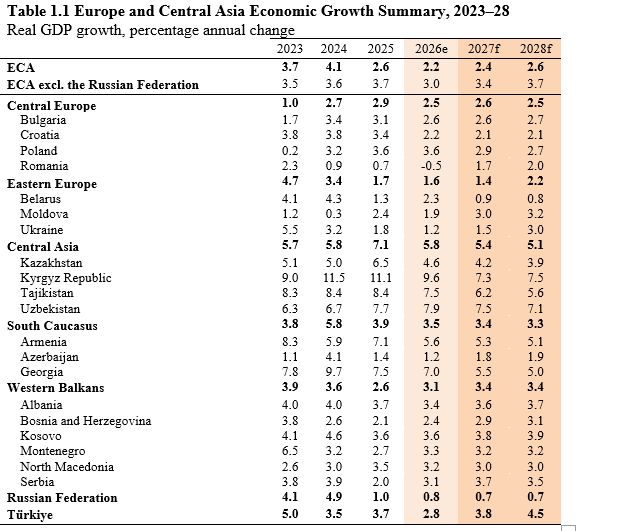
Amid higher energy prices, heightened uncertainty, and weaker economic expansion in trading partners, growth in Europe and Central Asia* is likely to slow to 2.2% in 2026 from 2.6% in 2025, according to the World Bank’s latest Europe and Central Asia Economic Update: Making AI Work: Jobs, Firms, and Productivity, released today.
The slowdown is broad-based, reflecting weakness in most countries in the region. Excluding Russia, which accounts for about 40% of the region’s output, growth is expected to moderate to 3% in 2026 from 3.7% in 2025. Global commodity-market disruptions have had a more limited impact than initially expected.
“Developing economies in the region continue to show resilience due to reduced energy intensity, stepped-up government policies, and robust domestic demand,” said Antonella Bassani, World Bank Vice President for Europe and Central Asia. “To increase productivity and help offset a shrinking working-age population, countries can harness the potential of artificial intelligence by strengthening foundational educational and managerial skills, while preparing labor market and social protection institutions for this disruptive change.”
Favorable labor-market conditions, rising real wages, remittances, tourist arrivals, and public investment have helped support economic growth. Temporary government relief measures have partly contained the impact of higher energy costs on households and firms, although in some countries they have added to fiscal pressures.
Central Asia remains the fastest-growing subregion, and is estimated to expand by 5.8% in 2026, with growth projected at 9.6% in the Kyrgyz Republic and 7.9% in Uzbekistan. Growth in the Western Balkans is likely to strengthen to 3.1% in 2026 from 2.6% in 2025, while Poland stands out in Central Europe with growth holding at 3.6%. Ukraine’s growth is expected to slow to 1.2% amid intensified damage to critical infrastructure and disruptions to exports.
Higher energy prices have kept inflation elevated, while sluggish growth in the European Union and rising competition from other countries are weighing on exports and industrial activity, particularly in the region’s automotive supply chains. Further disruptions to trade and continued hostilities in Ukraine, additional increases in energy, transport and fertilizer costs, tighter global financing conditions, weaker growth in key trading partners and extreme weather events remain key downside risks.
In a special focus on artificial intelligence, the report finds that AI is arriving faster than the region can currently absorb it. About one in five workers – predominantly well-educated and young – hold jobs meaningfully exposed to AI. Fewer than one in 10 firms currently use AI, mostly for basic tasks.
The region has many prerequisites for AI, including nearly universal mobile coverage, favorable energy costs, and strong technical talent. However, the report notes that adoption is hindered by a lack of foundational educational and managerial skills, integrated and interoperable data, and computing capacity.
“While the private sector needs to be the principal engine of adoption, adaptation, and innovation, readying the workforce for AI gives policymakers a real chance to tackle the jobs challenge and generate growth,” said Ivailo Izvorski, World Bank Chief Economist for Europe and Central Asia. “The main risk over the next decade is likely to be too little adoption and adaptation of AI across the region, not too much.”
Beyond making existing industries more efficient, AI could enable new products, services, occupations, and sectors. The two key ingredients to making this a reality are improved skills and much larger inflows of private capital. Governments could help catalyze such inflows by expanding affordable access to computing, thereby creating opportunities for computing-capacity exports provided demand exists.
*The region includes Central Europe, Eastern Europe, Central Asia, South Caucasus, Western Balkans, Russian Federation and Turkiye.
The full report can be downloaded here.